
What pattern size am I?
Watch our FREE video workshop on pattern sizing to learn more:

CHOOSING A SIZE
Our most frequently asked question revolves around selecting the right pattern size. Hence, we’re here to guide you through the three essential considerations when determining the size for your sewing project. Rest assured, all our patterns are multi-sized, ensuring a range of options to cater to your needs effectively. Let’s compare:
- Body measurements
- Pattern size chart
- Garment finished measurements
FIRST, you’ll need to know your accurate body measurements, not your Ready-To-Wear size. Our handy video guide will show you how to take all the measurements you need to get started.
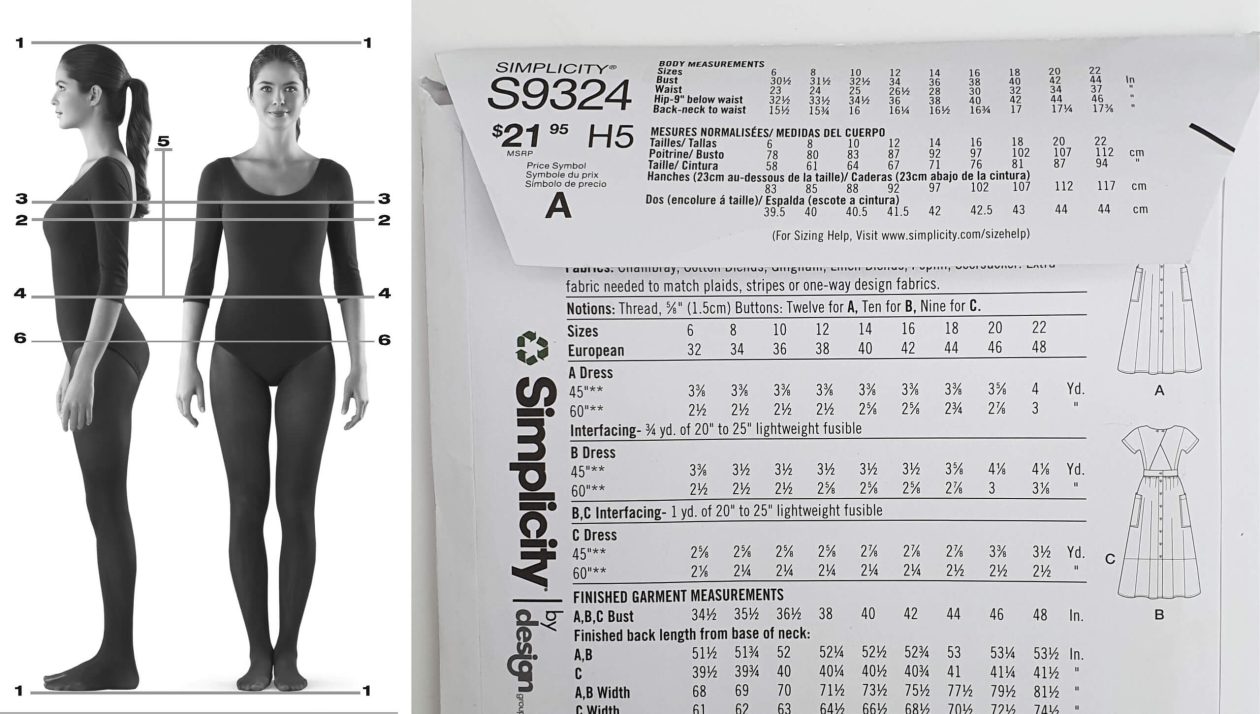
SECOND, you’ll want to look at the envelope flap for the size chart which will help you know which size pack to buy. You can also view these from any pattern’s product page or the Size Guides section of the website in our footer.
The charts align body measurements with corresponding sizes, which can be numerical or alphabetical. In certain patterns, sizes might be represented as bands, such as S = 8-10. Keep in mind that other pattern companies use different charts, so it’s unwise to presume consistency in sizing across all brands.
THIRD, you’ll want to check the finished garment measurements. The bust, waist and hip finished measurements are printed on the pattern tissue in the corresponding location. Plus certain finished measurements are on the back of many of pattern envelopes where space allows.
These will help you hone in on exactly what size to make, how to adjust the size and picture what the finished garment will look like before you start!
LET’S TALK ABOUT EASE
What exactly is ease? It’s the variance between your body measurements and those of the finished garment at the corresponding body part. But ease isn’t a one-size-fits-all concept; there are two main types: Wearing Ease and Design Ease.
Wearing ease is crucial for comfortable movement in the garment—think lifting your arms, sitting, and, of course, breathing. Personal preferences vary; some opt for more wearing ease for a relaxed fit, while others prefer less for a snugger feel. A general guideline suggests 1-2″ of ease, but adjusting for more can be beneficial, especially if dressing is challenging or fabric sensitivity is a concern.
On the other hand, design ease serves a specific aesthetic purpose, influencing the silhouette’s look. Vintage styles often feature minimal design ease, favoring a close fit, while coats and jackets incorporate ease for layering versatility. Some contemporary designs embrace exaggerated shapes with excess ease, like voluminous sleeves or balloon trousers, for dramatic effect.
Consider also the role of fabric in ease. Fabrics vary in stretch and give, affecting the amount of ease needed. Stretch fabrics like jersey require less ease, and if your woven fabric has some stretch, sizing down your garment might be an option.
Negative ease comes into play with stretch fabrics and patterns tailored for them. Here, the pattern accounts for the fabric’s stretch, resulting in a garment designed smaller than your body measurements. This technique, known as negative ease, ensures a close fit by leveraging the fabric’s stretch qualities, provided you select a fabric with the appropriate stretch percentage indicated by the Pick-a-Knit rule on your pattern envelope.
| Garment | Use this MEASUREMENT for correct size |
|---|---|
| Dresses, Tops, Jackets and Separates | BUST:Or if you have more than 2 1/2” (6.3cm) difference between and High Bust, select your pattern size using your HIGH BUST* measurement. |
| Skirts & Pants | WAIST measurement: (if your hips are two sizes or more larger than your waist, use HIP measurement. |
| Maternity | SAME PATTERN SIZE you used before pregnancy. |
| Between Two Sizes | SMALLER SIZE for a closer fit, or if you are small-boned, LARGER SIZE for a looser fit. |
Misses patterns are made for a B cup with 2 1/2″ (6.3cm) difference between Bust and High Bust measurement.”